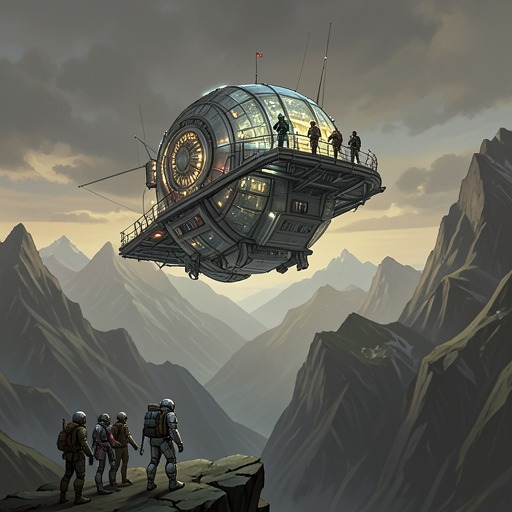
Space Force
Rock Falls, Everyone DiesThe Space Force is the surviving civilization’s military and exploratory arm in deep space, charged with advancing into unknown territory, confronting dangers before they threaten its people, and defending one of only three remaining colony ships. Its encounter with the rock exposes the limits of that mission: an institution built around sensors, engines, weapons, and energy signatures is forced to respond to an entity whose power is expressed through gravity and whose existence violates the rules its instruments are meant to measure.
Nature and Strategic Position
The Space Force operates after its home has been reduced to a broken heap by war. Only three great colony ships remain, making the defense of each vessel a matter of collective survival rather than an ordinary patrol assignment. The organization combines exploration with military protection: its vanguard units advance into the unknown, defeat dangers before they can reach the larger population, and investigate anomalies that might endanger the fleet.
This strategic burden is concentrated in a small two-mech reconnaissance pair. One machine is a worn, repurposed mining suit piloted by a veteran mechanic; the other is a larger, gleaming, high-technology unit operated by a young hotshot. Their mismatched equipment and contrasting experience do not weaken their assignment. They are the forward edge of a society with little margin for error, and their bond becomes part of the practical defense system on which the colony ship depends.
Reconnaissance and Command Infrastructure
The Space Force maintains communication with a red base while the pair searches for a destroyed scouting unit. Command reports that sensors continue to detect a gravity anomaly in the system and orders the pilots to remain alert. The exchange shows an organization that relies on centralized warning, remote coordination, and technological surveillance to make an otherwise immeasurable region legible.
The pilots’ methods reflect that infrastructure. The veteran reassures the younger operator by pointing to the absence of nuclear-class energy signatures and by arguing that the odds of hostile life appearing in the middle of the system are low. The reassurance is not based on certainty; it is a calculation produced by the Space Force’s existing categories of threat. The younger pilot’s unease, especially about the main ship trailing too close, therefore functions as an intuitive warning that the organization’s probability-based confidence has begun to fail.
Contact with the Gravity Anomaly
The mission changes abruptly when a sensor alert announces an object approaching at rapid speed. The veteran launches 100 homing photon missiles, but the weapon system cannot behave normally in the anomaly’s field. The missiles veer off course and crash into one another as though they have fallen into a deep gravitational well. The veteran reports that no energy signatures are registering and calls for a visual identification, revealing a widening gap between what the Space Force can detect and what is actually approaching.
When the pilots finally engage the rock, their weapons continue to encounter unfamiliar rules. Beams evade the rock’s attempt to block them and strike its rear, prompting the veteran to claim a hit. The system immediately identifies the target as violating the rules of thermodynamics. The warning is more than a battlefield diagnosis: it marks the point at which the Space Force’s technological interface becomes an inadequate explanation of the threat. Its sensors can announce an anomaly, its weapons can attack it, and its systems can classify the result as impossible, but none of those tools can make the target intelligible.
Institutional Limits and Consequences
The Space Force’s encounter demonstrates that military superiority is conditional on a stable physical environment. Its missiles, thrusters, sensors, and energy classifications presume that objects can be tracked, propulsion can be controlled, and attacks can be distinguished from one another. The rock’s gravity disrupts each assumption at once. The resulting danger is not simply that a weapon misses; the organization’s entire chain of observation, interpretation, and response is placed under pressure.
The broader narrative repeatedly presents power through system messages and measurable transformations. Energy can trigger safeguards when an ability exceeds its safety limit, and entities can be marked as overloaded when damage reaches impossible scales. The Space Force belongs to the same world of numerical and technical mediation, yet its instruments encounter a being whose growth eventually reaches planetary dimensions. The organization’s anomaly is therefore the early military appearance of a much larger ontological problem: the object it treats as a hostile target is becoming a form of celestial power that cannot remain inside ordinary military categories.
Narrative Significance
The Space Force provides the perspective of a threatened civilization accustomed to defending itself through organized technology. Its two pilots bring human-scale urgency to the rock’s otherwise vast progression, while the damaged colony fleet establishes the stakes behind their patrol. Their mission begins as a rational search for a missing scout and a known gravitational irregularity, but it ends at the edge of a reality in which a rock can become a planet, fuse with surrounding matter, and create new forms of beauty over geological time.
That contrast gives the organization a structural role beyond combat. The Space Force represents the old scale of power: ships, mechs, command channels, weapon inventories, and defensive probabilities. The rock represents a new scale in which planets, stars, and even grains of sand belong to the same fundamental category of stone, differing chiefly in size and power. By placing the two in conflict, the narrative turns a military patrol into a test of whether an established institution can recognize an entirely new kind of being before its procedures become irrelevant.